
Is AI Killing Illustration?
AI Art is Everywhere. How Should Illustrators Deal With It?

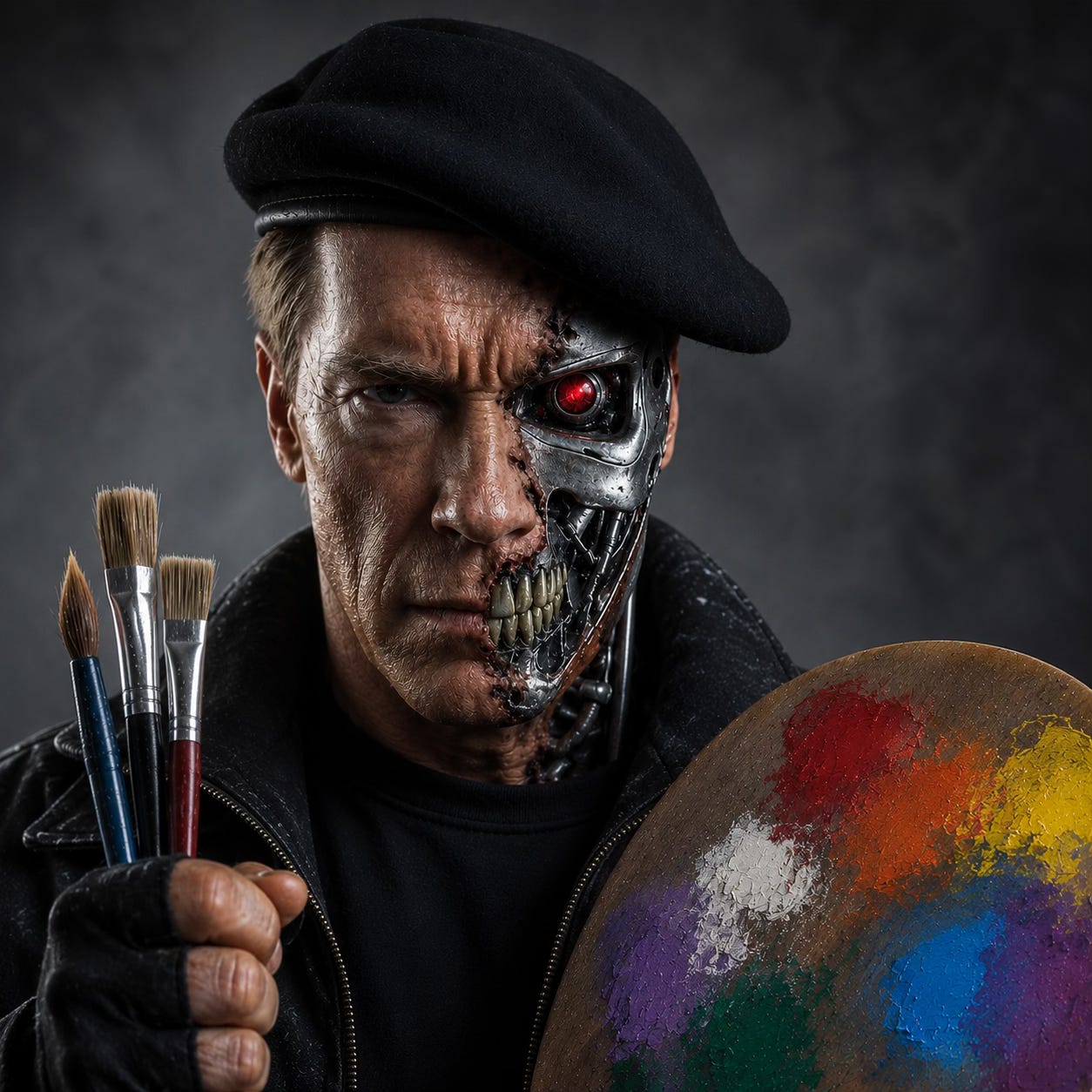
Computers can now draw and paint almost as quickly as a camera takes a photograph. What does that mean for the illustration industry? Is human artwork dead, or about to be?
I’ve been a professional illustrator running my own studio for thirty years. I’ve worked on projects for Disney, Hasbro, McDonald’s, General Mills, and Coca-Cola. Like everyone else who draws pictures for a living, I’d be lying if I didn’t say AI is making me a little nervous. Just how much of a threat is AI to those of us who still draw with our hands?
(Full disclosure: To research this post I read several articles, watched multiple videos, experimented with AI generation tools, and yes even asked ChatGPT to draft an outline just to see what it would do. From all of that research I picked out the ideas I thought made the most sense when filtered through my years of experience. And yes, obviously I created the above image with the help of AI. I took a photo from Google, painted over it, and then prompted an AI for the final render. Point is, AI was one of many resources I used in writing this post.)
Why AI Is Nothing New
Progress means change. Change comes with a cost. It always has and always will.
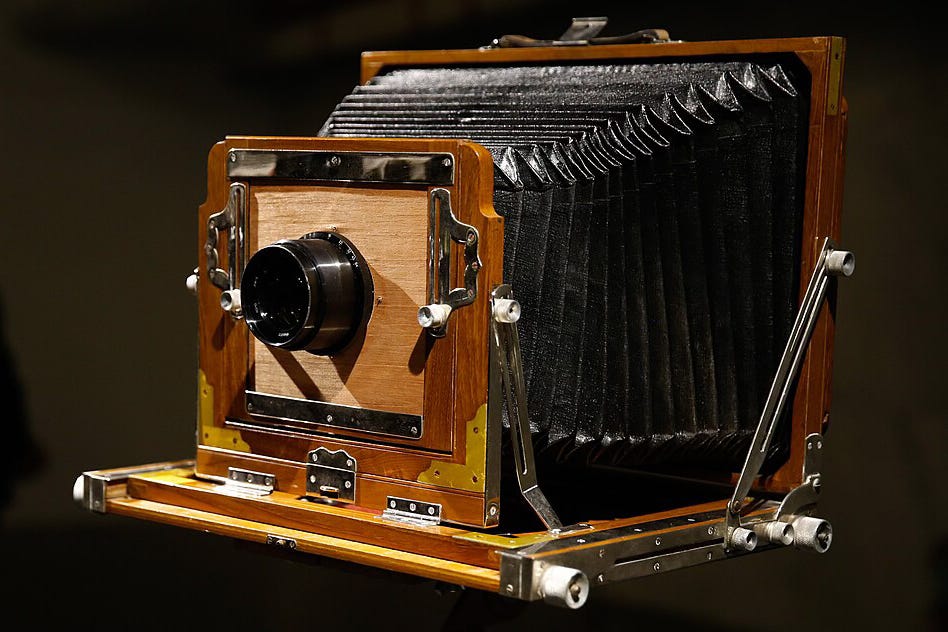
For most of human history if you wanted an image you had to hire an artist to draw or paint one. Then along came the camera. Suddenly there was a machine that could create a perfect likeness instantly with the simple push of a button. A dark cloud of doom hovered over the art world. Why hire a human artist when a camera is so much faster, cheaper, and more accurate?
For a while the world’s painters were in a cold sweat. Then artists did what artists do best: They got creative! They began exploring and pushing boundaries and trying new things. Pretty soon we had Impressionism and Art Deco and Cubism and Graphic Design and Cartooning. Whole new worlds opened up, all thanks to the threat of photography. Today illustrators even use photos as reference to improve their skills. Yes artists had to adapt—almost nobody makes a living painting portraits anymore—but over time artists found new ways to thrive side by side with their former enemy, the camera.
Maybe I’m naive but I like to think something similar will happen with AI. Just as artists now use photography to help them make better art, I’m hopeful we will adapt to using AI to help us create art in new ways never before imagined.
Is AI A Threat?
The bad news is that yes, just as the camera replaced the traditional portrait painter, AI today is replacing some traditional illustrators. Progress always comes with a cost.
But I don’t think it’s nearly as bad as it looks.
AI is crazy good at certain things: It can render a detailed image extremely fast. It can give you multiple variations of an image. It can imitate popular styles. It can brainstorm ideas quickly. It can create instant backgrounds. It can adjust the lighting and mood of an image without breaking a sweat.
All of which means there are certain creative jobs that AI will soon dominate. Any projects where the art can be generic, derivative, or just “good enough” will go to AI. Here’s some art jobs that are probably on the “doomed” list:
Stock illustration (clip art)
Simple background and patterns
Low-end coloring and activity books
Preliminary brainstorming
Anything trying to copy a popular trend.
AI is also becoming a go-to for projects that have little or no budget such as:
Blogs (like the image at the top of this post)
Self-published books
Website filler art
Social media promotions
Event fliers
Budget logos and mascots for small businesses
AI *is* a real threat to these types of illustration. Clients with low budgets, or who just need average art that lacks originality, will use AI “slop” because it’s fast, easy, and free.
Basically the Fiverr crowd is moving to AI.
Unfortunately the illustrators most hurt by this will be the young ones just starting out. In the past those low-budget jobs were the place to cut your teeth, gain experience working with clients, and build a portfolio of actual published work. Many young illustrators will now have fewer options. All is not lost—there are still “beginner” clients out there who either object to AI on principle or who are just not tech savvy enough to use it—but competition for those scraps will be fiercer, and budgets will be lower. Young, talented go-getters may have to start inventing their own sample projects just to show what they are capable of.
AI is also pushing client expectations through the roof. Clients who don’t understand or appreciate the creative process now expect art to be made faster than ever and cheaper than ever. Even experienced pros are feeling the pinch.
Skill vs. Slop: Where Artists Still Have An Advantage
All is not doom and gloom. AI still has some massive limitations, at least in its current form.
So far this year I’ve had four different clients come to me with some version of this: “I tried getting AI to make what I want. I don’t like it/can’t use it. Will you make a better version for me?” This gives me hope.
Of course AI is in its infancy and is evolving fast, so things may change. But as of right now AI struggles or outright flops in several key areas:
Originality. AI learns by studying patterns. It looks at what everyone else is doing and imitates what it sees, with results that are often generic, derivative, and stale. If you ask it to come up with something truly fresh and original, it doesn’t really know what to do. Projects like packaging, mascot creation, advertising, and branding all require art that stands out as unique and special. That’s the opposite of how AI “thinks”. AI struggles to understand anything that works by disrupting a pattern. Things like humor, metaphors, or just plain thinking outside the box make no sense to AI.
Intention. AI understands pixels but not meaning. The algorithm knows what a cartoon squirrel looks like but it doesn’t understand why you need one as your mascot, or what the mascot means for your brand. AI knows the what but not the why, so it struggles to stay on-brand and on-message.
Consistency. People using AI to create graphic novels or children’s books are noticing something odd: An AI character rendered on page 1 often looks totally different by page 13. This may change in the future but right now consistency over multiple iterations is a real and persistent problem.
Revisions. AI is surprisingly terrible at making tweaks and changes. Many image generators can’t process a simple command like “Rotate the flower basket 45 degrees”. This might change as AI gets better but right now it is a massive headache for clients who need to make tweaks here and there.
Translating vague client directions like “make it more friendly”. AI needs specifics. It can’t feel inspired. It has no intuition or taste or gut feeling.
Production-ready files. Currently any image AI gives you won’t have editable layers. It often fumbles die lines and spot colors, and it still struggles to create clean, production-ready vector art. All of which means that clients who use AI wind up with flawed files that have massive limitations or, in some cases, are just plain unusable. This also may change but right now it’s another huge weakness of AI.
Copyright and trademarks. Under current US law an image that was 100% AI-generated can’t be copyrighted. There has to be at least some human effort in the creation of the image, though exactly how much has not yet been settled in the courts. Legally AI copyright is a very gray area. Many clients need to have full copyright ownership of anything connected to their brand, which severely limits how they can use AI.
Things are moving fast and some of these problems may be solved in the near future, but I suspect many of them are not going away.
As things currently stand, AI excels at making art that is fast but mediocre, cheap but limited. For some client projects, that’s fine. If the client just wants “a picture”, AI wins. But if they need original thinking, style, creativity, and connection with an audience, humans still dominate. I don’t have a crystal ball but it seems to me that illustrators who adapt to become strong in these areas will have the best chance of surviving, even thriving, in the age of AI. The successful illustrators will be the ones who can consistently deliver artwork that is “anti-slop”, to clients who appreciate and need it.
How To Make Yourself More Valuable
Commercial illustration has always been about the client, not the artist. That hasn’t changed. Ultimately your job is to solve your client’s problems and make them look good. Being not just an artist but a creative partner matters now more than ever.
Clients don’t just buy art; they buy reliability, communication, and problem solving. These are all areas in which a human can pull ahead of AI. Some clients still prize originality, confidence, reliability, and creative excellence, and are willing to pay for it.
Here are a few things you can do to increase your chances of those clients hiring you:
Don’t market yourself as just an illustrator. Be a creative partner. Don’t just say “I draw illustrations”. Tell them “I design mascots to help brands connect with their audience” or “I help clients succeed using visual communication”.
Be professional. Good communication, reliability, problem solving, and the ability to meet deadlines have always been important, but they really matter now. Despite all the advances in AI, ultimately clients are buying reliability not pixels. An artist who communicates well, is easy to work with, and who delivers solid work on time will stand out more than you might think.
Develop a personal style. Creating average, generic work is now risky because that’s what AI excels at. Show that you can make art that is beautiful but also unique. AI makes average work cheaper, but it also makes distinct work more valuable. Clients that need originality and differentiation will pay more for that.
Specialize. Being a jack-of-all-trades, master-of-none makes you especially vulnerable to AI competition. Instead, choose one industry (or a small handful of industries) and focus on meeting their specific needs. Being specialized makes you more valuable to the people who need that specialty, and it makes you harder to replace.
Be a creative thinker. Get good at brainstorming, playing around, and thinking outside the box. Those are real skills that, like drawing, can be improved with practice. The more you can strengthen those muscles, the more you will stand out in a world of generic AI slop.
Be a problem solver. Most clients don’t really care how the art gets made. They care about getting something that meets their need. It’s not good enough to just be able to draw. You have to also be good at understanding the client’s goals, interpreting their ideas, and then translating it all into something creative that they can benefit from.
Be fast. Like it or not, AI is accelerating deadlines for everyone at every step of the process. Artists who can iterate quickly and pivot on a dime will stand out. Don’t overpromise (not keeping your word is a big freelancing sin), but realize that working fast is now the norm.
Position yourself as AI-fluent. Don’t be an “AI artist”, but do be a human who understands how AI works and who knows how to leverage it. One way or another your clients are using AI. Like it or not you will have to learn to speak that language and meet them on that playing field.
Work smarter, not harder. The illustration industry is now more competitive than ever. You can still create artwork by hand, but that doesn’t mean you can’t use AI to make you more efficient and to help you manage your time. Use it to help gather image reference, to help brainstorm ideas, to experiment with colors and textures. Use AI to improve your marketing (targeting clients, researching hashtags, punching up your social media posts, etc.) Use AI to help you analyze trends and plan your business. Because if you don’t, your competition will.
Whatever you do, don’t ignore AI. The world’s largest companies and most powerful governments are all pouring billions of dollars into an AI arms race. AI is not going away. Artists who ignore it will fall behind.
No one can see the future, including me. AI is disrupting everything and the next few years are going to be tumultuous. Artists are facing challenges unlike anything that has come before. But I believe there is still hope.
Computers are much better than people at playing chess, but nobody wants to watch two computers play each other. If there’s no human drama, what’s the point? By the same token, I don’t think people want to live in a society where the creative spirit has been outsourced to machines. Humans are made in God’s image which means we are designed to create. It’s hard-wired into our souls. One way or another, artistic expression will always be part of the human experience. Authentic man-made art will always be needed.
So keep creating!

Nice post, Cedric. I think this 'graph below is key. I was just talking to an old colleague last night, and we both think that, at some point, people will prize authenticity:
"Be a creative thinker. Get good at brainstorming, playing around, and thinking outside the box. Those are real skills that, like drawing, can be improved with practice. The more you can strengthen those muscles, the more you will stand out in a world of generic AI slop."